
A Year Off Gas...!
All electric hot water tank
Well... a bit more than a year, but as you know, when it comes to posting late, we have form. Having done the House Planning Help podcast - which was great fun, thanks Ben! - I thought I'd covered it all already... If you missed it, here it is, with a brilliant summary by Janice Gardner in the show notes.
Installing the Mixergy tank
September 2024 and I finally got round to contacting Jon at H2O Renewables for a heat pump and Mixergy tank installation.

I'd first heard about Mixergy when I visited the Zetland Road EnerPHit projects, designed and developed by Ecospheric, and on Carbon Coop's Green Homes tour. It's a smart tank.
Jon came round and talked me out of getting a heat pump – which I was considering in a moment of doubt (see previous post): his reasoning was that given everything we’d done fabric wise, and the fact that the earth floor had likely needed more heat input initially than the calculations suggested to dry out, we were better off keeping it simple. I tend to agree, even with hindsight.
So we did, and we hired him (and his two sons) to take out the boiler and install just the Mixergy tank. We still went for an indirect cylinder, in case a heat pump was a possibility in the future – and with Mixergy the heat exchanger is external to the tank so can easily be tagged on.
J also convinced me to put the tank in the loft rather than the landing cupboard where the boiler was housed, releasing some storage space. This fried my brain – tanks are only C rated for insulation – but on balance, it ended up being OK: the tank uses machine learning to heat up only what we need when we need, so standing losses are minimised. The only drawback for us, as we switch off the WiFi at night, is that when it’s offline it heats up to 40% of the volume at midnight regardless, but we still view this as a considerable saving.
The PV diverter will use excess generated solar energy and “dump” that into the hot water tank, regardless of the power available – in other words whether the panels are producing an excess of 500 W or 2 kW, that will be energy that gets transferred to the immersion element and heat our water during the day. This means we make maximum use of our rooftop solar generation before exporting to the grid, and that we hardly draw any grid energy for hot water in the summer months, despite not having a battery.
We’ve since also managed to shoe-horn the washing machine into the cupboard and this makes laundry much easier to deal with from a space-flow perspective – and gives us more flexibility to remodel the bathroom in due course!
There is a holiday mode, which means no energy is used while you’re away, until a few hours before your return time to make sure you have hot water on arrival, all controllable by the app.
We did manually wrap the tank with insulation, but we’re going to have another go at this as there are gaps: coming back to this January’s cold snap after being away for two weeks, I wasn’t particularly relaxed about it all. I needn’t have worried in this instance: the tank controller has a frost protection cycle, but it hadn't felt the need to kick in as the water in the tank was still staying just above 5 oC.
We have 1kW total installed heat input downstairs so I set the thermostat on the panel rads to 17 oC while we were gone. They merrily modulated and clicked on and off – I could see this from my SolarEdge app – until they were on nearly constantly towards the end of the two weeks and despite us coming back to a temperature of -8 oC that morning, the house was at 14.5 oC. I’d say that was a result, given I’d kept the MVHR running on Low, thus providing fresh air for all that time.
Off gas for a year: the data!
We have over a year’s worth of data off gas now so it’s probably time for a look back at what we’ve achieved. When I’d made the decision to go all electric, without a heat pump, electricity was still at 14p/kWh.
As the rate has now doubled – with a higher peak of 36p at some point – perhaps a heat pump might have been an investment - and we would have needed a loan - but let’s not forget that we have reduced our total energy demand at source by over 80% since 2018! I have to keep reminding myself that these are lasting reductions as they are mainly due to fabric measures – insulation and airtightness - which are the 'hard to do' measures.
We’re still using our friends’ temporary plug in heaters to top up (5kW total), because a) we’re a bit tight for cash right now – having splashed out on new floor coverings in the bedrooms (carpets, be gone!) – and b) I can’t get the electrician back except for emergencies (like, when we’ve blown the lighting circuits). But the plan is to install a total of 4.5 kW throughout the house with a central digital controller.
Our total, all electric, energy bill (for all consumption) for 2025 was therefore £1,217 (incl. daily charges of £202), minus our export from the solar panels of £227, for a resulting energy cost of £990, or £82 / month, which is good, and considering our shockingly low Solar Export rate. I had delegated the switch to a different SEG tariff to my other half, which we finally managed to do last month. So we should be getting a better revenue on the export for 2026. We have also saved £150 in gas standing charges.
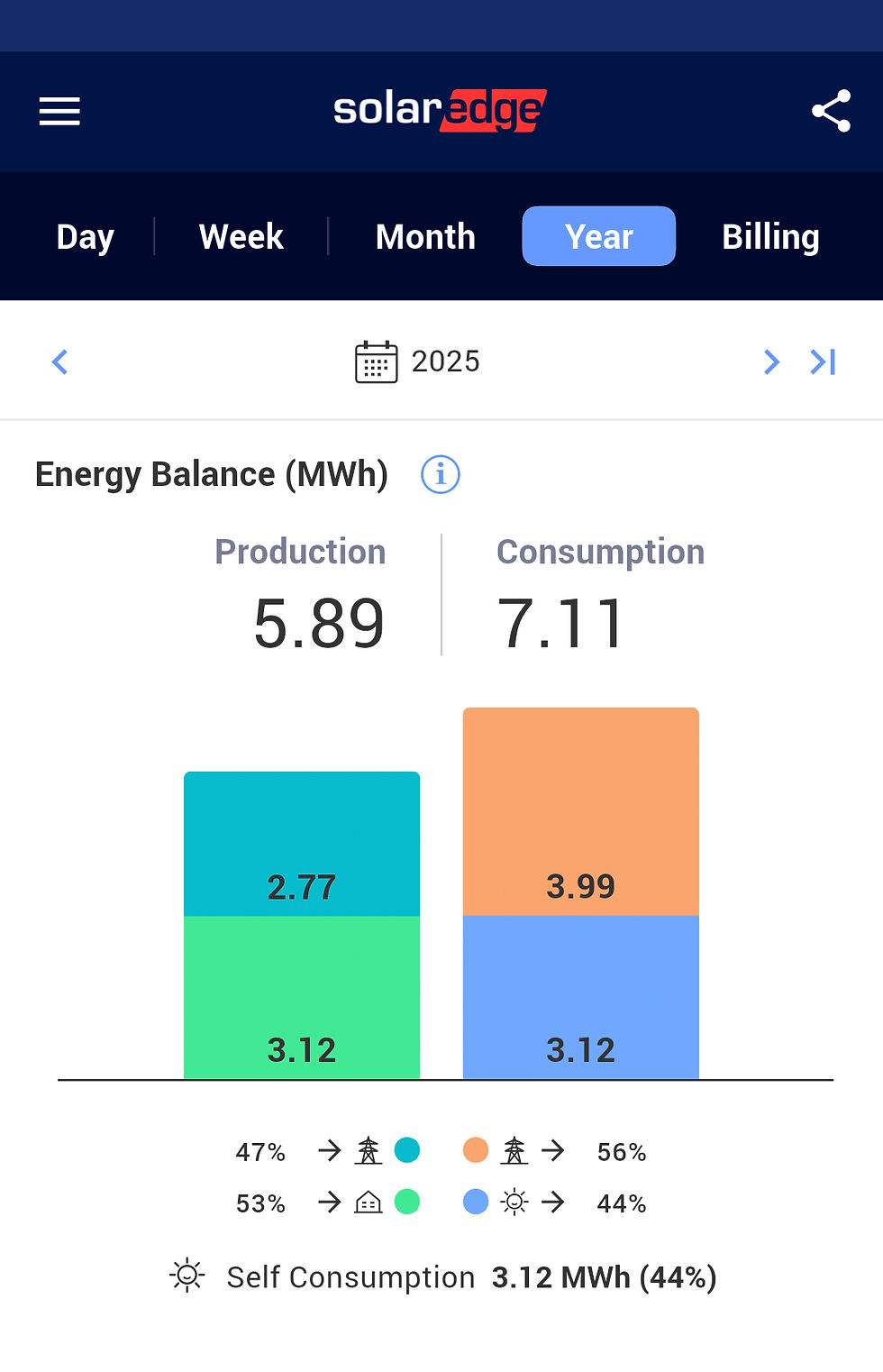
As you can see, we haven't managed to make ourselves energy neutral over the year, for which we'd need a heat pump, or a few extra solar panels on our East facing pitch. Let's see if we can improve on that next year.
From what I can see on (equally anectodatal) LinkedIn posts, heat pump installations without major fabric improvements can be consuming only slightly higher amounts of energy, principally by taking advantage dynamic energy tariffs.
We do however enjoy high levels of comfort, although my teenagers disagree as I still like to keep the house on the cool side of 19 oC! (I remember being like them until not so long ago, menopause and all that!). Their showers are also scorchingly hot. We've achieved our main aims: thermal comfort, improved acoustics, no draught fresh air and an allergen free haven. Not to mention more bearable summer months. I love working from and spending time at home. It wasn't quite the financial killing we'd anticipated, but this is mainly due to factors beyond our control, so we've certainly insulated ourselves from the worst impacts - I can't imagine what our bills would be now had we kept going as we had in 2018.
The airtightness measures – ceiling works finished in July 2025 (more detail in the next post) and some tightening up of the earth floor along the perimeter, closing off the vents in the cavity wall and filling the cavity below door thresholds – seem to have made a significant contribution. Even after the gloomiest November on record (much reduced solar gain), our grid import consumption that month was 472 kWh, compared with 640 kWh for the same period in 2024. It was probably milder too, but that’s a significant drop nonetheless (26%). Let's see what 2026 looks like...
And here are figures for the Mixergy tank, which I was super impressed with - if you ignore December which had an app error and is incorrect (we were away for ten days with NO hot water generation, and it doesn't match up to our smart meter data). The PV diverter is allowing us to make the most of the solar generation without having a battery (see the self consumption graph tracking).
Monthly data (blue is self consumption) | Mixergy mothly data | A sunny day in May 2025
We need to improve the insulation of the tank in our cold loft to avoid some of the cold weather on/off cycling that’s happening to maintain minimum volumes / temperature. And fixing leaks from degraded washers and replacing the shower bar helped curb additional losses. But overall consumption data was a pleasant surprise.
The other thing I meant to install and completely forgot about was a water softener. Although we're in a soft water area, I do remember a local plumber telling me it was enough to fur up an element in a water tank and that they installed them as standard now. We will be rectifying this when we get our tank serviced later in the year.
In terms of an eventual heat pump, this could still be retrofitted, and we may do that when they’re more affordable. In our case the most pragmatic installation would be an air-to-air reversible HP, with just one indoor unit in the living/dining space at ground floor – or a small propane (R290, super low GWP refrigerant) air-to-water ASHP with an indoor fan coil unit. You could set the space to have a slightly higher daytime temperature of 21-22 oC in winter and the rest of the house would equal out at between 18 and 20 oC – that would be my guess anyway, based on how we’ve strategically used the heat input we have so far.
Any questions, get in touch!
Costs
Mixergy Tank
£2,845.20 incl. VAT
Stripout and tank installation
£4,014.00 incl. VAT
Gas meter decommissioning
£165
Gas pipework capped off in street
FREE a year later as UU routine safety measure
Total Hot Water / Coming off gas: £7,024.20
Total Retrofit to date: £105,909.76 (£962.82/m2)


Comments